The Unlearned Lessons of Nazi Propaganda: Goebbels’ Rhetoric and Modern Politics
Prologue: The Allure of History: Navigating Times of Uncertainty
Today it has become popular again to quote historical events out of context and to refer to history. As far as I can remember, there was a similar tendency at the beginning of the new millennium. In fact, one could say that I too have recently felt the need to constantly return to historical events. I think the times of uncertainty in which we live encourage such a tendency in order to find a way forward. Still, one might ask, what is the point of writing such an article today and revisiting historical events? I wrote this article just recently, a few months ago, but I would like to say that it is as relevant today as when it was first written. People seem to forget that there have been more conflicts between nations than we can count throughout history, and that there have been very few periods in the world that have been completely free of war. Perhaps there has never been true peace in history. And yet somehow trade, diplomacy, and international relations have flourished. I think there is one important exception: the indelible and dark Nazi era of the last century. The most important aspect of this period, which is difficult to forget forever, is that it systematically “dehumanized” certain categories of people by dividing them according to a racial hierarchy. As this language took root over the years, people reached a different level of consciousness and became capable of committing all kinds of evil at any time. Historical events can drag people and societies into arduous struggles. Regardless of the outcome, one critical issue that cannot be overlooked is the importance of being mindful of the language we use. Therefore, I believe that people from all walks of life should consider this topic today.
Enemy Brothers: The Contradictions of Twentieth-Century Powers
The last century was a period of significant political upheaval and tension. There were great powers, in a sense “enemy brothers,” ready to fight each other at any moment. The expression “enemy brothers” is one that carries significant weight. These two forces are in fact brothers, as they are both sworn enemies and opposing forces that emerged at a certain stage in the development of the same modern Great Enlightenment Tradition. They are inextricably linked and take a stance and position in relation to each other. Walter Benjamin likened this situation to puppet theater in his work Passages. As one becomes the mirror image of the other, they reach a point where they forget where they started the fight, what they are actually defending, and what their aims are.
The Twentieth Century provided two significant and distressing illustrations of this phenomenon. The first of these must be the experience of the Second World War. In this war, the Nazis, who flourished with the indulgence of the “liberal and Western plutocracies” (!) waged a war to the death against the Bolsheviks to destroy what they called the Jewish-Bolshevik conspiracy and defeated. Then capitalist and socialist forces engaged in a great struggle among themselves. Ultimately, one of the powers collapsed, and the world order that they had barely maintained by opposing each other was disappeared.
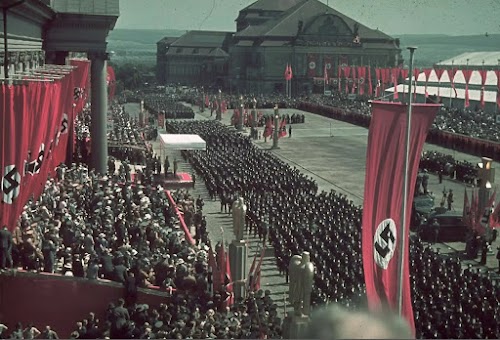
The aforementioned phenomena were not merely great military and political power struggles. Furthermore, there were new interpretations of the philosophy of history that were introduced. To be more precise, we observed the intensive efforts of political forces who claimed to philosophize history in line with their ideologies in the last century. These political forces were quick to reinterpret their own history and traditions in line with the requirements of their current political regimes, or in other words, to “invent” them. The most radical and, in my opinion, bizarre examples of this were provided by fascist Germany, which added a kind of cultural and “civilizational” war dimension to the conflict.
Goebbels’ Shadow: The Architect of Nazi Propaganda
It is important to note that the establishment of the Nazi ideology was not solely the responsibility of jurists and thinkers such as Carl Schmitt and Martin Heidegger, who are recognized worldwide and have a certain weight in their fields. The most significant and under-emphasized share belongs to Dr. Joseph Goebbels, the Reich’s Minister of Propaganda. A thorough analysis of the archives from that period reveals that many of Hitler’s statements can be seen as a continuation and even a repetition of Goebbels’ ideas. It should be noted that Goebbels’ role extended beyond attending large public meetings and delivering radio speeches. He was also a prolific writer of articles and propaganda booklets. We were amazed to discover today that these documents totaled hundreds of pages.
Goebbels was a committed Nazi ideologue, serving in this capacity not only during Hitler’s rise to power but also until his death and until his final moments. He has a particular interest in historical philosophy, Roman history, and the Germanic past. He is critical of modern art, science, and psychoanalysis. Like his “master”, he was a great admirer of Richard Wagner. Many of the Reich’s well-known and frequently discussed cultural policies have been developed as a result of his profound interest in the subject. This interest is driven by a commitment to innovating “tradition” and the German past.
Echoes of a Dark Past: Contemporary Political Language
In order to clarify the main purpose of why this article was written, I would like to draw your attention to one point, which is that, unfortunately, a kind of political language that has become popular again today is strongly reminiscent of the Nazi past and especially of the ideological line used by Goebbels. A recurring theme in contemporary political discourse is the necessity and even the goodness of a world war characterized by mass destruction. Accompanying this theme are certain judgments about monsters, demons, and superior and inferior civilizations as part of the war in question. As you will soon read, I find it hard to believe that themes such as the decisive influence of history and “extraordinary forces” in politics, the over-generalizing corrupt West, corrupt culture, the children of the devil, savage and “primitive races”, etc., are used so casually and rudely today, because I am amazed at how easily people can be convinced that these uses are harmless in light of the lessons of the past.
Goebbels’ Final Rhetoric: A World in Ruins
For this reason, in this concise article, I have selected to include some excerpts from Goebbels’ speeches, not only during the rise of the Reich and fascism, but also and especially at a time when its downfall was almost inevitable. The expressions used in these speeches can be considered a starting point from which the dominant language of today’s politics echoes. Goebbels, Hitler’s propaganda minister, delivered regular radio speeches annually under the title “Our Hitler.” The final speech was delivered in the context of the dissolution of the Third Reich. The victory of the Soviet and Allied armies is almost certain, and it is only a matter of time before they reach Berlin. However, this inexorable advance was not the end for the Nazi leadership. If it is an end at all, it will mark the end of a unique “civilization,” the end of “high civilization,” and the world will surrender to the “evil” victory of the “Western plutocracies” and the octopus arms of “International Bolshevism.” It was on this date, 20 April 1945, that the last of Goebbels’ “Our Hitler” speeches was delivered, as Hitler himself was on the verge of taking his own life.
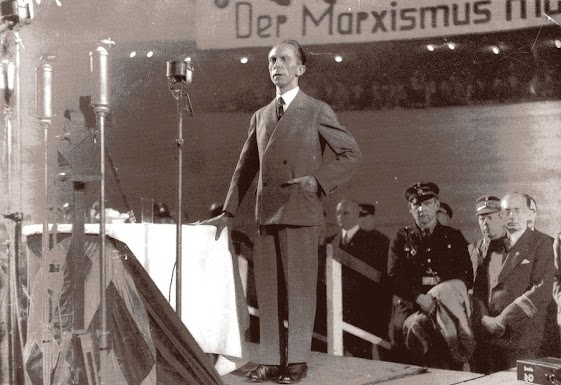
In this speech Goebbels states;
Opposing this apparently all-powerful coalition of destructive satanic forces brings with it tests and burdens of superhuman nature, but that is not dishonorable — the opposite in fact! To bravely accept a battle that is unavoidable and inescapable, to wage it in the name of divine providence, to have confidence in it and its eventual blessing, to stand before fate with a pure conscience and clean hands, to bear all suffering and every test, never even thinking of being untrue to one’s historic mission, never wavering even in the most difficult hours of the final battle — that is not only manly, it is also German in the best sense of the word! Would our people not accept this task and not fight for it as if it were the word of god, it would not deserve to live any longer, and would lose any possibility of further life.
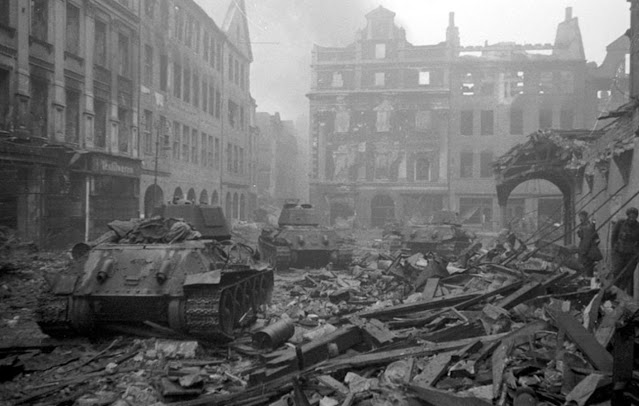
This means that, just as God has given “certain nations and high cultures” a mission today, so God has given the Germans a historical responsibility, an honorable and unavoidable mission! And that is to stand up “manfully” to the evil forces of the West as a representative of the true, authentic civilization, and this task will be carried out to the end, at all costs.
Goebbels continues;
The perverted coalition between plutocracy and Bolshevism is collapsing! (…) Once more the armies of the enemy powers storm against our defensive fronts. Behind them is the slavering force of International Jewry that wants no peace until it has reached its satanic goal of world destruction. But its hopes are in vain! As he has done so often before, god will throw Lucifer back into the abyss even as he stands before the gates of power over all the peoples. A man of truly timeless greatness, of unique courage, of a steadfastness that elevates the hearts of some and shakes those of others, will be his tool. Who will maintain that this man can be found in the leadership of Bolshevism or plutocracy? No, the German people bore him. It chose him, it by free election made him Führer. It knows his works of peace and now wants to bear and fight the war that was forced upon him until its successful end.
After emphasizing that the “evil coalition” united against the German people had already begun to disintegrate, Goebbels stated that there was every reason to be hopeful about future political events;
Within a few years after the war, Germany will flourish as never before. Its ruined landscapes and provinces will be filled with new, more beautiful cities and villages in which happy people dwell. All of Europe will share in this prosperity. We will again be friends of all peoples of good will, and will work together with them to repair the grave wounds that scar the face of our noble continent. Our daily bread will grow on rich fields of grain, stilling the hunger of the millions who today suffer and starve. There will be jobs in plenitude, the deepest source of human happiness, from which will come blessing and strength for all. Chaos will vanish. The underworld will not rule this part of the world, but rather order, peace, and prosperity.
That was always our goal! It is our goal today. If the enemy powers had their way, humanity would drown in a sea of blood and tears. War would follow war and revolution would follow revolution, finally destroying the last remnants of a world that was once beautiful and lovely, and that will be so again.
But if we achieve our goals, the project of social construction begun in Germany in 1933 and was rudely interrupted in 1939 will be taken up again with renewed strength. Other peoples will join in — not because we force them to, but rather of their own free will — because there is no other way out of the world crisis. Who could show the way save the Führer! His work is the work of order. His enemies have only a devil’s work of anarchy and devastation to set against his work.
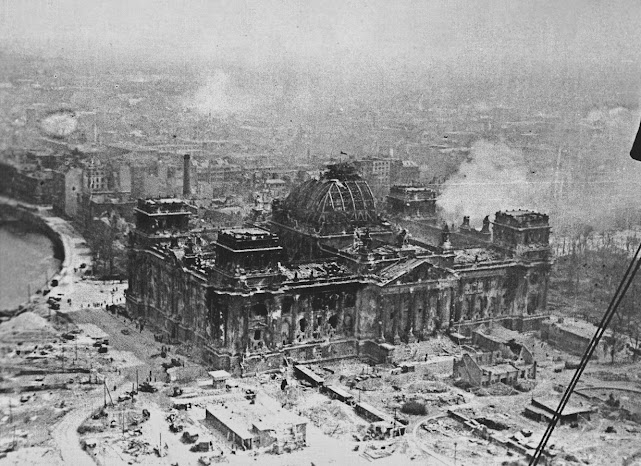
In essence, Goebbels, akin to certain contemporary elements, promoted the establishment of order and “authentic civilisation” as a counterbalance to demonic chaos and destruction. He asserted that this could only be achieved under the leadership of Germany. It is noteworthy that, in justifying this speech, he cites a philosopher of historical philosophy such as Burckhardt, who can be regarded as conservative. The message is clear, and it appears to have been received. In his final speeches, Goebbels also emphasized the importance of various peoples and values, particularly those of the German people. He stated that the “owners” of a divine, pure and true civilisation had a responsibility to protect these values from what he referred to as “destructive” and “satanic” civilisations. He further asserted that the liberation of these peoples was a divine duty. Indeed, it was only when the Germans surrendered to their enemies in the ruins of the war, a situation in which they were helpless and humiliated, that they realized that they had become a “mass society” indoctrinated by a “savior” and “liberating” mission. However, the team never fully recovered from the psychological impact of this significant loss. The concept of ‘selected and constitutive traumas’ has been adopted from the psychological literature and incorporated into the terminology of political science. These concepts refer to distressing events that shape a community’s sense of self and its perception of others. Examples of this include the exile of the Jews, the wars and destructions that have been wrought, and genocides and mass killings. In fact, Goebbels, who sought refuge from the Western “plutocracies” to combat Bolshevism and “sought help” from them, was also referring to Burckhardt and the philosophy of history, implying that the final outcome had yet to be determined.
The Philosophy of Propaganda: Inferiority and Betrayal
In his article “History as a Teacher“, written at roughly the same time and discussing the philosophy of history, Goebbels stated;
In the long run, we are convinced that the present heroic struggle of our people will result in the proudest empire that history has ever seen. But this depends only on us. Every great individual action today, whether in battles or in suffering and endurance, is a stone on which to build. There will come a time when nothing we have to endure today will have been in vain. We frankly confess that when we look around us in the midst of this cruel and wicked age, we feel better about the great heroes of human history than we do about the bought-and-paid-for newspaper columnists in London, Washington and Moscow, who adjust their flags to the wind and are always ready to belittle today what they worshipped yesterday. However, they can never offer support or solace at critical times. Neither Alexander nor Fabius, neither Scipio nor Caesar, neither the great German Kaisers nor the great Prussian kings, none of them would have behaved differently in our situation today than we do today. None of them would have abandoned their courageous determination in the face of the destructive fury of the enemy, or, as Clausewitz said, sacrificed the history of the world for a page of a lying newspaper. This is how we feel, this is how we think and this is how we will always act.
If so-called public opinion in hostile countries advises us otherwise, as we all know, it is not in our interests, but entirely in their own. They want to win a cheap victory over us using a hypocritical rhetoric that they will abandon with cruel cynicism as soon as they succeed, and we will be the losers. What is left of those peoples who abandoned our side and took refuge with the enemy? They would sing hymns of praise if they could replace their present hopeless situation with the tolerable conditions that existed before the surrender. But it is too late for that now. They chose the wrong wisdom. Instead of following the dictates of national duty and honor, they must pay now and will have to pay even more in the future. History has no mercy on subjugated peoples. It shows them its most terrible cruelty and punishes them for not being brave and courageous in body and spirit until the third and fourth generations. This should be remembered by all those who today have lost their overview of events and can no longer distinguish between what is essential and what is not. History is a strict teacher. It rarely repeats its admonitions and rarely gives second chances to peoples and leaders who try to ignore its laws. That is why we must submit to its stern advice, no matter how much it hurts us every day. As long as we do not give up hope of national survival and surrender ourselves to the mercy of the enemy, we have no choice.”
As can be seen in this “fiery rhetoric” of Goebbels, one speaks of enemies who are morally and humanly inferior to themselves; the hostile forces are openly humiliated. When the topic turns to human inferiority, it is crucial to understand that this perspective is not merely rhetorical hyperbole but rather a well-considered viewpoint held by fascists. The term ‘humanly inferior’ is defined as ‘inferior to humans.’ The term is used to denote a level of inferiority in terms of human characteristics when compared to other animals, such as monkeys, ants, frogs, and various invertebrates. These are people who are motivated by greed for money and profit, who lack the capacity to build and develop civilization, who are culturally and linguistically limited, and who are no better than animals. If they fail to prove themselves before history, it will be the children of the Germans who will pay for the defeat suffered by these inferior people.
Lessons Unlearned: The Resurgence of Militarism and Fascism
Significant setbacks, despondency, and the traumas of disintegration can have repercussions for individuals and nations. I have recently completed an article on the subject of the atomic bomb and nuclear warfare. In order to reflect the fearful atmosphere of the last century, I drew on real events and my childhood memories as a first-hand witness. In my opinion, the aforementioned ideological elements pose a greater threat than the atomic bomb. Not even the mass and instantaneous extinction caused by a nuclear apocalypse can humiliate the human species to such an extent. In the current geopolitical climate, there is a resurgence of militarism and fascism. We observe its manifestations in numerous locations. In today’s world, there are individuals, communities, and societies that view the world through the lens of their traumas, hatreds, and obsessions.
As far as I know, fascism was dealt with. Today, I am compelled to pose the following question, albeit with a sense of trepidation and a tinge of sadness.
Or has the last word not been said?
● ONUR AYDEMİR ●
● 2024, ANKARA ●